1 in 3 dentists say they are not busy enough ADA Health Policy Institute, Q1 2026 (PDF)
1 in 5 practices do not have enough administrative staff ADA Health Policy Institute, Q1 2026 (PDF)
58% of dentists who recruited admin staff called it very or extremely challenging ADA Health Policy Institute, Q1 2026 (PDF)
The actual problem

The expensive call sounds exactly like the cheap one.

It is 6:40 on a Thursday. Your front desk is chairside helping finish a cleaning, the last patient of the day is at the counter with a question about her benefits, and the phone rings.

The caller has a bridge that finally gave out. He has been putting off an implant consult for two years and decided tonight is the night. He gets four rings and a greeting. He does not leave a message. He goes back to the map, taps the next practice, and somebody there picks up.

You will never know that call happened. It does not appear in your production report, it does not appear in your recall list, and it does not appear in your software. The only place it exists is a phone log, sitting next to nine other numbers somebody meant to call back.

That is the part most answering-service pitches skip. The problem is not call volume. The problem is that a single-tooth implant inquiry, a post-op patient with swelling, and a “do you take Delta” question all arrive on the same line, in the same tone, and nobody can tell them apart until somebody answers. When the front desk is short-staffed, the triage that decides which of those three gets a human is happening by accident.

The ADA Health Policy Institute put numbers on the squeeze in its Q1 2026 update (PDF). One-third of dentists say they are not busy enough, up from roughly a quarter in early 2024. One in five practices reports it does not have enough administrative staff. Among dentists who tried to recruit admin staff in the previous three months, 58% called it “very” or “extremely” challenging. Open chairs, a thin front desk, and a hiring market that keeps not cooperating. That is the shape of it.

We wrote about the general version of this problem in stop missing after-hours calls. This page is the dental-specific version.
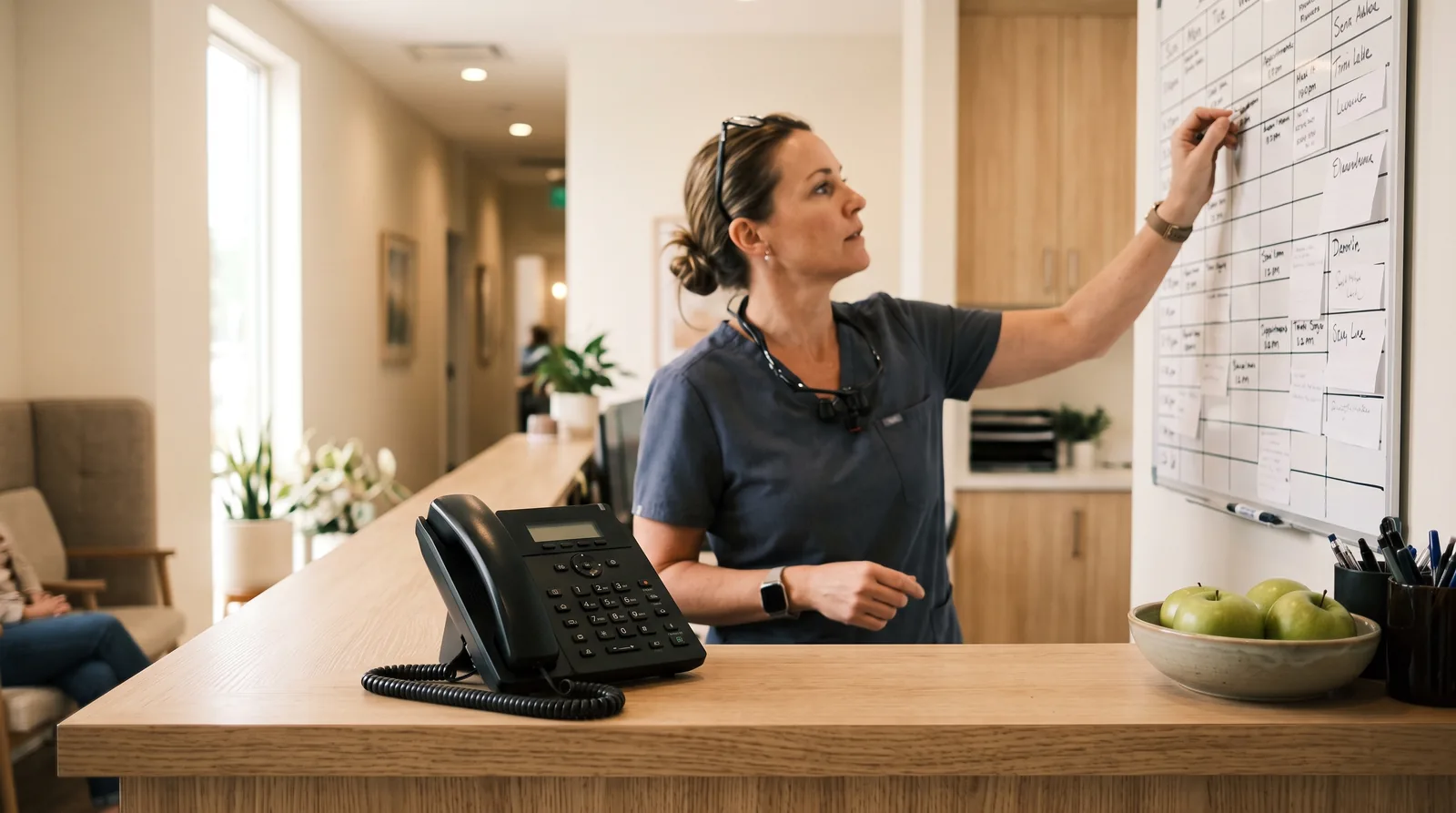
A desk phone in sharp focus on a dental practice front desk, with the administrator out of focus behind it, reaching toward a wall schedule

The 6:40pm call, arriving while the front desk is already busy · Illustrative

What gets built

Three jobs, handled on the call instead of after it.

Pillar 01

Answer, every time

  • Picks up on the first ring at 6:40pm, on Saturday, and while both lines are already busy
  • Configured with your hours, your providers, and the procedures you actually offer, not a generic dental script
  • Captures name, callback number, carrier, and the reason for the call in plain language
  • Delivers a written summary to your front desk instead of a voicemail somebody has to sit through and transcribe
Pillar 02

Sort by urgency and value

  • Separates a new-patient implant or sedation inquiry from a routine reschedule
  • Flags pain, swelling, trauma, and post-op calls for a human immediately
  • Follows the after-hours protocol you wrote, including who gets paged and when
  • Everything else queues for the morning instead of turning into a 9pm callback list
Pillar 03

Hand off cleanly

  • Books into the calendar your team already works from, with the caller’s details where the front desk expects to find them
  • Texts the caller what happens next, plus the intake link if you use one
  • Follows up automatically when a new-patient inquiry never books
  • Weekly summary of every call, what it was about, and what happened to it

This is the same three-pillar shape as Tier 01, Reclaim, scoped to a dental front desk.

On the call

What it does with each kind of caller.

Every row below is configured during your build. None of it is a default setting.
Type of call What the agent does Where it ends up
High-value new patient
Implant or full-arch inquiry Answers, confirms you offer it, captures how they found you and what they are trying to fix, offers the next consult slot Booked, with a text to the front desk
Sedation or anxious caller Confirms sedation is offered, captures what specifically worries them, books the consult. Gives no clinical opinion Booked, flagged for a clinical callback
Urgent
Pain, swelling, or trauma after hours Runs your written protocol, gathers the details you specified, states what happens next Pages whoever is on call by text or phone
Post-op question Captures the procedure, the date, and the symptom. Offers no clinical guidance Routed to the clinical team, not the front desk
Routine
Reschedule or cancellation Confirms who is calling and which appointment, offers the next opening Calendar updated, front desk notified
Insurance or cost question Answers only from the language you approved. Never improvises coverage or quotes a fee you did not write down Answered live, or queued with the exact question asked
Sales call or wrong number Ends the call Nothing reaches your team
Straight answers

Three things the vendor pages tend to skip.

Practice-management write-back is the hard part

Almost every page in this category says it integrates with your practice management software. In practice, two-way write-back into dental PMS is narrower than the marketing suggests, and what is possible depends on your specific system, your version, and whether the vendor exposes an interface you are permitted to use on your plan. Before quoting, we check what your setup will actually allow. If the honest answer is “the agent books into a calendar and your front desk mirrors it,” that is what we will tell you. It is still a real improvement over a voicemail box. It is not a native write-back, and calling it one would be a lie you would discover in week three.

HIPAA is a scoping conversation, not a badge

Whether a phone system is acceptable under HIPAA depends on what data it collects, where recordings and transcripts live, who can access them, and whether a Business Associate Agreement is signed. Any company can put a compliance logo on a landing page. Ask them, and ask us, for the BAA in writing, ask where the audio is stored and for how long, and ask exactly what the agent is configured to capture. We settle all of that in writing during scoping. If your requirements are stricter than what a build can honestly deliver, you will hear that on the first call rather than after an invoice.

It should not practice dentistry

An AI receptionist is a front desk, not a clinician. We configure it to gather facts and route them. It does not diagnose, it does not tell a patient whether they need a root canal, and it does not decide whether swelling is urgent. It runs the protocol you wrote and escalates to the person whose job that judgment is. A phone agent that improvises clinical advice is a liability with a friendly voice.

Run the number first

Size it before you talk to anyone.

Put your own call volume and average case value into the missed-call cost calculator. If the number is small, do nothing. If it is not, book the call.

Book a 30-minute call
Common questions

What dentists ask before booking.

Will my patients know they’re talking to a machine?

Most will work it out, and that is fine. What matters to someone calling at 6:40pm is whether anybody answered and whether their problem got handled. We configure the agent to say plainly that it is an automated assistant for your practice when a caller asks, and to hand off to a person when the call is not something a front-desk script can solve. The failure mode worth designing against is not sounding synthetic. It is stalling a caller who needs a human.

Does it connect to my practice management software?

Sometimes directly, more often through a calendar plus a written handoff. Two-way write-back into dental practice management systems depends on your specific software, your version, and whether an API is available to you on your plan. We check that before quoting and tell you exactly which of the two you are getting. We do not list integrations we have not confirmed against your actual system.

Is this HIPAA compliant?

That question has to be answered about a configuration, not about a product. It depends on what the agent is set up to collect, where call audio and transcripts are stored, who can access them, and whether a Business Associate Agreement is signed. We work through all four with you in writing during scoping, before the build starts. If your compliance requirements are stricter than what can honestly be delivered, we will say so on the call and you will not have spent anything.

What happens on a real after-hours emergency?

It follows the protocol you write. Typically that means the agent collects the caller’s name, callback number, what happened and when, then pages whoever is on call by text or phone, and tells the patient what to expect next. It does not triage. Deciding whether swelling is an airway problem is clinical judgment and it stays with a clinician.

What does it cost, and am I locked into a subscription?

Builds start at $1,500 as a one-time cost, scoped to what your practice actually needs. After that, a care plan is optional and starts at $75 per month, which covers monitoring, prompt tuning, and small changes. A higher, more active management tier runs closer to $300 per month if you want that level of involvement. Acuity does not bill you per call or per minute, and does not mark up your usage. Platform usage is a separate cost you do pay: Vapi and your phone provider bill you directly, at their published rates, and that scales with how many calls you take. Vapi lists its rates at vapi.ai/pricing. The finished system belongs to you, so if you stop paying for a care plan you keep what was built.

How long until it’s live?

Plan on 3–6 weeks from kickoff for a single-location practice. The slow parts are usually not technical. They are getting your after-hours protocol written down, agreeing on what the agent is allowed to say about insurance and cost, and forwarding or porting the number. Expect to spend roughly two hours of your own time across kickoff, a midpoint review, and handover.

More general questions are answered on the main FAQ page, and the build sequence is on how we work.

Take the next step

Let’s find the call you’re losing.

Thirty minutes. We’ll tell you what we’d build for your practice, what it would cost, and whether it’s worth doing at all.

Book a 30-minute call
Book a discovery call