At 2am the job goes to whoever picks up.
A phone line that answers every emergency call, asks the questions your dispatcher would ask, and pages the on-call tech with the address and the damage details before the homeowner reaches the next name on their list.
Rated 5.0 on Google. Based in Missoula, Montana. Working with restoration operators across the United States.
Voicemail is a decision to lose the job.
It’s 11:40 on a Tuesday night. A supply line behind a washing machine lets go and there is an inch of water moving across a finished basement. The homeowner is standing in it with a phone in one hand and three search results open in the other. They are not leaving a voicemail. They are dialing the next number.
The reason they will not wait until morning is physical, not emotional. The EPA’s guidance on moisture is blunt: if wet materials are dried within 24 to 48 hours of a leak or spill, in most cases mold will not grow. Every hour that passes pushes the job from drying toward demolition, and the homeowner feels that even if they could not cite the source. That clock is why an emergency caller keeps dialing instead of waiting for a callback. It is also why the call you return at 7:14am is usually a call you have already lost.
The common fix is an answering service, or lately an off-the-shelf bot, that picks up, takes a name and a number, and emails it over. That answers the phone. It does not capture the job. A message sitting in an inbox at 2am gets read at seven, and by seven somebody else has air movers on the floor and a signed work authorization. The question was never whether the phone got answered. It was whether anything happened in the next fifteen minutes.
This is not a rare event, either. The Insurance Information Institute puts water damage and freezing among the most frequent homeowners claims, at roughly one insured home in sixty every single year. The calls are out there tonight. The only open question is whose phone they land on and whether that phone does anything useful.
There is a longer walkthrough of where a generic answering service falls down in our post on how restoration companies can answer every emergency call. This page is about what actually gets built instead.
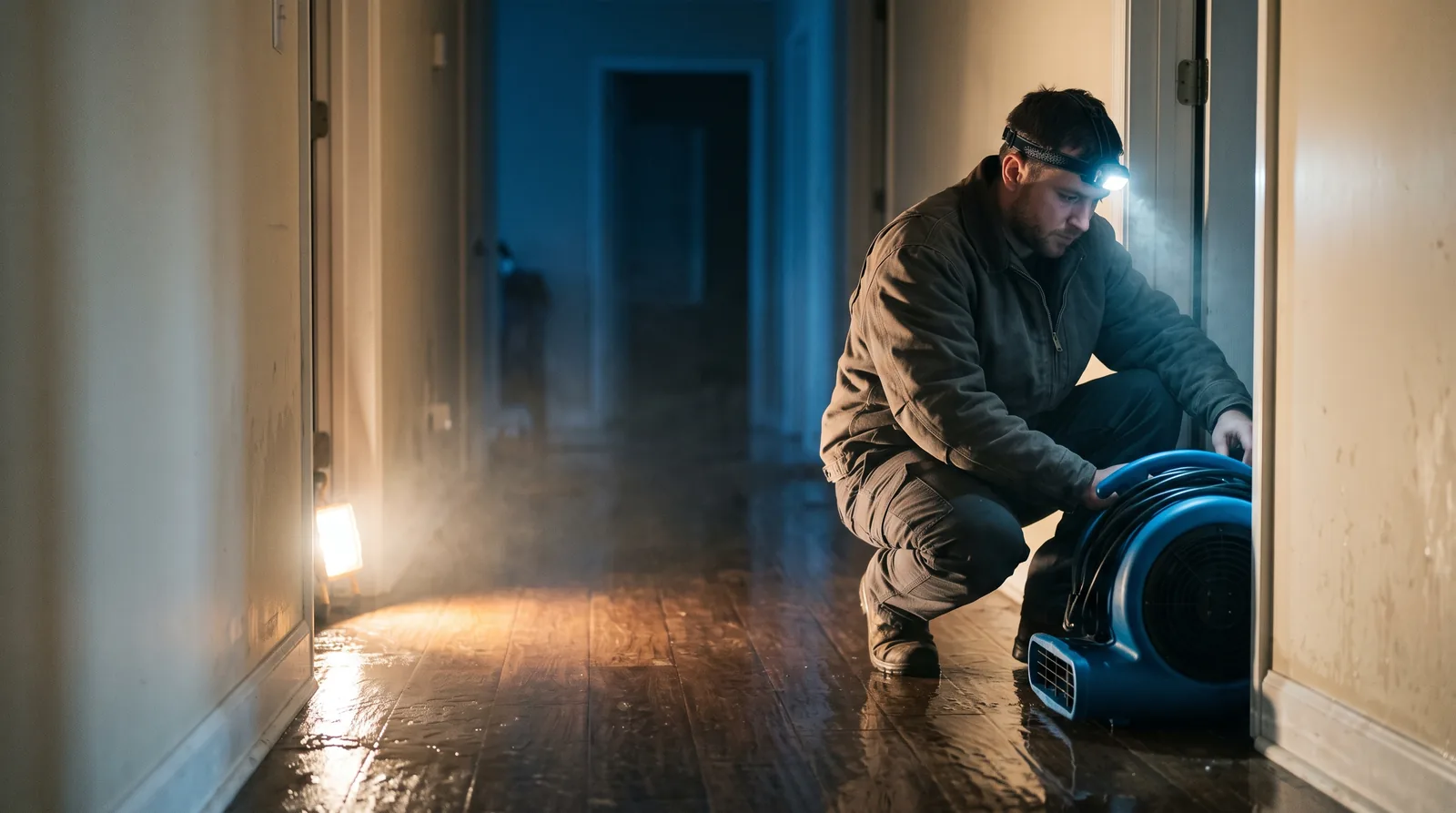
Illustrative · A water loss, first hour on site
Three things get built. Nothing else.
Answer and triage
- Picks up on the first or second ring, every hour of every day, holidays included
- Establishes what happened: water, fire, smoke, mold, storm, or a routine callback
- Asks whether water is still running and whether power is on, before anything else
- Captures the address, the cross street, and how a tech gets in at night
- Separates a live emergency from a Monday-morning estimate request and routes them differently
Dispatch and page
- A confirmed emergency pages the tech who is actually on call, by name, with the intake attached
- The rotation follows the schedule you already run, not a generic round robin
- If the first number does not answer, it moves to the second, then the third
- The caller gets a confirmation and a window, so they stop working down the list
- Non-emergencies get booked into the schedule without waking anybody
The record
- Writes a structured lead into the CRM or job board you already use
- Damage type, severity, address, carrier, and claim number land in real fields
- Recording and transcript attach to the job for the adjuster conversation later
- Nobody rekeys a voicemail transcript at 7am
- The morning queue is sorted before the first truck rolls
What it asks, and who should not buy it.
Most pages selling this describe it as “24/7 answering” and stop. That is the easy half. The half that decides whether the job is won is the intake, and the intake has to match how your shop actually scopes a loss. Here is the shape of a restoration script, written out, so you can tell in about ninety seconds whether it resembles what your dispatcher already does.
A water loss, at 11:40pm
- Where the water came from. A supply line and a sewer backup are the same phone call and two completely different jobs. The ANSI/IICRC S500 Standard for Professional Water Damage Restoration sorts losses into water categories, and the answer changes what gets loaded on the truck before anyone leaves the shop.
- Whether it is still running. If the shutoff has not been found, that gets walked through on the call, while the caller is still on the phone, before dispatch is even decided.
- Standing water and power. Both are safety questions. Both change who you are willing to send and what they bring.
- Affected area and how many floors. A closet and a finished basement are not the same estimate, and the difference decides how much equipment goes out tonight.
- When it started. Two hours ago and “since Sunday” are the difference between drying and demoing. Asking at intake stops the surprise on arrival.
- Insurance carrier and claim number, if one exists. Asked once, at midnight, so nobody has to call back and ask twice on Wednesday.
- Access at night. Gate code, dog, lockbox, whether anyone will physically be there to meet the tech at 1am.
- A callback number that is not the flooded landline. Small detail. It is the one everybody forgets, and it is the reason a good lead sometimes goes cold.
When you should not buy this.
If what you want is a cheaper voicemail, do not hire us. There are off-the-shelf products that answer the phone and take a message for very little money. Rosie’s published plans start at $49 a month for 250 minutes, and if a name and a number landing in your inbox is genuinely enough for how you run, that is the right purchase and we would rather you make it than overpay us. Pricing checked 29 July 2026, and it changes without notice, so check theirs before you decide. It is also not an apples-to-apples number. Their monthly fee meters your minutes and caps them by plan tier. A build here is a one-time fee plus an optional care plan, with the platform minutes underneath billed to you directly by Vapi and your phone carrier at their published rates, not marked up by us.
What is on this page is for the operator who already tried that and watched the job go elsewhere anyway, because nobody was paged, nobody drove, and the message was still sitting there at seven. If your losses are large enough that one recovered emergency job pays for the build, the math is straightforward. If they are not, it is honestly not worth doing yet.
The fundamentals here are the same ones described in Tier 01, Reclaim, scoped to how a restoration shop actually dispatches rather than bolted on top of it.
Want the number first?
Put your own call volume and average job value into the missed-call cost calculator. If the number that comes back does not bother you, close the tab with our blessing. If it does, book the call.
Book a 30-minute callThe things restoration owners ask first.
How is this different from an answering service?
An answering service takes a message. This takes the intake. The difference shows up after the call ends: a confirmed emergency pages your on-call tech by name with the address, the damage type, and the access notes already collected, and the caller is told someone is on the way. A message sitting in your inbox at 2am gets read at seven, and by seven the job is usually gone.
Will it sound like a robot to someone whose basement is flooding?
It sounds like a calm person asking short questions in a sensible order. It does not pretend to be a human, and it says so if a caller asks. What matters more to a homeowner standing in water at midnight is that somebody answered and somebody is coming. You tune the script, the pacing, and the questions before it ever takes a live call, and you listen to real recordings until it sounds like your company.
What does it cost, and is there a per-call fee?
Builds start at $1,500, one time, scoped and quoted on the call before any work begins. After that, an optional care plan starts at $75 a month and covers monitoring, prompt tuning, and small changes. A more active management tier runs higher, closer to $300 a month. Acuity does not bill you per call or per minute. The platform underneath does meter, though: you pay Vapi and your phone provider directly, at their published rates, and we do not mark that up. That usage scales with call volume, so a bad storm week does cost more than a quiet one. Vapi publishes its rates at vapi.ai/pricing.
Do I own it, or am I renting it?
You own it. The phone number, the assistant configuration, the workflows, and the account credentials are yours, and they stay yours if you stop working with us. Built for you, owned by you. That is the reason the pricing is a build fee rather than a subscription you can never stop paying.
Can it reach the right tech on the right night?
Yes, and that is most of the work. The on-call rotation follows the schedule you already run rather than a generic round robin. If the first person does not pick up, it moves to the next number and keeps going until someone acknowledges. You decide how many attempts it makes and how long it waits between them.
What happens on a call it cannot handle?
It hands off. Anything outside what it was built for gets transferred to a live number or escalated by rules you set, with the transcript attached so whoever picks up is not starting cold. It is built to fail loudly to a person rather than quietly to voicemail.
More general questions about how engagements run are answered on the main FAQ page.
Find the call you’re losing at 2am.
Thirty minutes. We’ll tell you what we’d build, what it would cost, and whether it’s worth doing at all.
Book a 30-minute call