The patient who called at 6pm booked somewhere else.
A phone system that answers every inbound call, quotes only what you have approved it to quote, books the consult against real availability, and keeps working the no-show list after your coordinator has gone home.
Missoula, Montana · Remote nationwide · Rated 5.0 on Google
It is 6:10 on a Thursday.
Someone saw your before-and-after reel at lunch, thought about it all afternoon, and is finally calling. Your coordinator left at five. The line rings four times and rolls to voicemail.
They do not leave a message. They go back to the map results and tap the next pin. That caller was not price shopping and was not a tire kicker. They had already decided they wanted the treatment. They were calling to book, and the only thing that stopped them was that nobody picked up.
Speed is the whole game here, and it is measurable. Harvard Business Review audited 2,241 U.S. companies with test inquiries and found that firms responding within an hour were nearly seven times more likely to qualify the lead than firms that responded later. Twenty-three percent of the companies audited never responded at all (Oldroyd, McElheran & Elkington, HBR, March 2011). That study was about web leads, not aesthetics phone calls, but the mechanism is the same one you already know: attention decays fast, and a returned call the next morning is a different conversation than a live one at 6:10.
The second leak is quieter. A Cochrane review of seven randomized trials covering 5,841 patients found that mobile phone text reminders raised attendance at healthcare appointments to 78.6%, against 67.8% with no reminder (Gurol-Urganci et al., Cochrane Database of Systematic Reviews, 2013). That is a real, measured effect from a genuinely boring intervention. Most practices already have reminders switched on somewhere in their booking platform. What almost none of them have is anything that acts when the reminder gets ignored, or when the cancellation lands at 8am and the slot quietly sits empty for the rest of the week.
If you want the arithmetic on your own numbers rather than ours, the missed-call cost calculator takes about two minutes, and the longer version of this argument is in the three revenue leaks every med spa has.
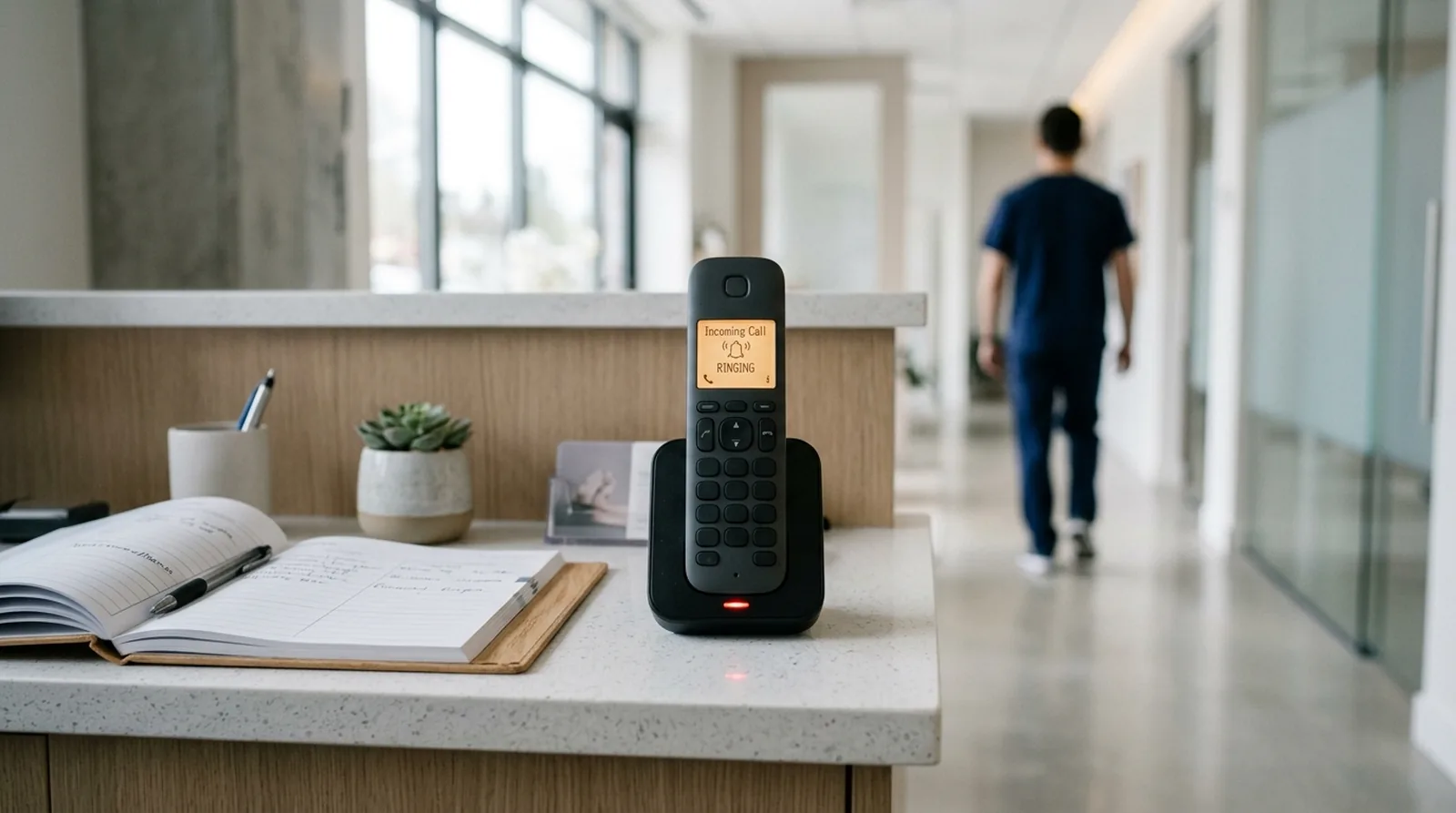
Illustrative · Nobody is at the desk. The phone still rings.
Three pieces. Scoped to your practice.
Answering and booking
- Every inbound call answered, including evenings, weekends, and while the third line is ringing
- Caller qualified against your real intake questions, not a generic script
- Your published menu, your hours, your devices. It only says what you approved
- The consult booked against live availability, or captured in full if your platform will not accept a write
- Every call transcribed and logged so nobody has to reconstruct it from memory
Follow-up nobody has to remember
- Reminder sequence timed to your no-show pattern, with confirmation tracked, not assumed
- A cancellation triggers a rebooking path the same hour instead of the next week
- Consults that came in but never converted get a second touch on a schedule you set
- Lapsed patients move into a re-engagement sequence rather than into nothing
- One weekly summary in your inbox: calls answered, consults booked, what slipped
Connected to what you run
- Built on n8n, which publishes 1,900+ integrations, plus a custom connection for anything that does not have one
- We verify what your scheduler and CRM will actually accept before you get a number, not after
- Where a platform is closed, we tell you on the call and design around it in the open
- No rekeying between the phone, the calendar, and wherever you track patients
What Thursday evening looks like once it is running
6:10pm. The call is answered on the second ring. The agent asks what the caller is interested in, whether they have had the treatment before, and when they are generally free. It quotes the consult fee from your published menu and nothing else.
6:13pm. The consult is on the calendar. A confirmation text goes out with the address and what to expect. The transcript and the caller’s answers are sitting in your CRM.
Next Tuesday, 8:02am. That patient cancels. Within the hour a rebooking link tied to real availability goes out, and the open slot surfaces to whoever is filling gaps that week.
This describes how the system is designed to behave, not a customer outcomePatient information, and the honest version.
We are not going to tell you this is HIPAA compliant. Compliance is a property of a specific deployment plus a signed agreement, not a badge that ships with a product. Anyone selling you the badge is describing marketing, not architecture.
Here is what is actually true underneath. Vapi, the voice platform these builds run on, states in its own documentation that HIPAA mode requires an enterprise subscription or a separately purchased add-on, that a signed business associate agreement has to be in place before it can be turned on, and that protected health information may only pass through one specific endpoint. Those are real constraints with real cost attached, and you should know about them before you sign anything, not after.
The practical consequence is better news than it sounds. A large share of med spa front-desk work does not require collecting clinical detail at all: hours, directions, what a first consult involves, whether you carry a particular device, the fee on your published menu, and getting a new patient onto the calendar. Scoped that way, the agent never needs to hold anything sensitive, and the build stays simple. If your situation genuinely needs more than that, we scope it deliberately and price it honestly rather than pretending the question does not exist.
Decided before anything gets built
- What the agent is allowed to ask, in writing
- What it must never ask, in writing
- Where transcripts and recordings live, and how long they stay there
- Who on your team can see them
- Which of your existing vendors need an agreement in place first
- Exactly what happens on a call that turns clinical
What it will not do
- No clinical advice, no triage, no telling a caller whether they are a candidate
- No quoting a price you have not approved in writing
- No promising an outcome, a downtime window, or a result
- No pretending to be a person. A caller who asks gets told, and gets offered a human
If those boundaries make the system less useful to you than you hoped, that is worth finding out on a call rather than three weeks into a build. The way we run an engagement is designed to surface that early, and the general questions are answered on the FAQ page.
Want the number first?
Run your own call volume and consult value through the missed-call cost calculator. If the number bothers you, book the call. If it does not, you have saved yourself thirty minutes.
Book a 30-minute callWhat practices ask before booking.
Will it sound like a robot to my patients?
It sounds like a competent person on a phone, and it picks up faster than your hold music does. It is also not trying to fool anyone. If a caller asks whether they are talking to a person, the agent tells them no and offers to reach someone on your team.
Can it book into the scheduler we already use?
Often, and we confirm it before you get a quote rather than after. If your platform has an open API or a supported connector, the agent writes the booking straight into it against real availability. If it does not, we say so on the call and design around it, which usually means the agent captures the full request and your coordinator confirms it the next morning.
Is this HIPAA compliant?
Not by default, and any product sold to you as HIPAA compliant out of the box is selling a badge rather than a configuration. Vapi, the voice platform these builds run on, requires an enterprise plan or a paid add-on plus a signed business associate agreement before HIPAA mode can be enabled at all. We scope what the agent may ask, what gets stored, and for how long. If your build genuinely needs to touch protected health information, we tell you what that changes about cost and timeline before you commit to anything.
What does a build like this cost?
Builds start at $1,500 as a one-time, custom-scoped project, so the number moves with how many systems have to talk to each other. After that, a care plan is optional and starts at $75 a month, which covers monitoring, prompt tuning, and small changes. A higher, more active management tier runs closer to $300 a month if you want us in it week to week. Platform usage is separate and you pay it directly: Vapi and your phone provider do bill by the minute, at their published rates, and that cost scales with how many calls you take. Vapi lists its rates at vapi.ai/pricing. Acuity does not mark that up and does not bill you per call or per minute. You own the finished system, so if you stop paying for a care plan you keep what was built.
What happens on a call that turns clinical?
It gets handed off. The agent answers questions about hours, your published menu, whether you carry a particular device, and what happens at a first consult. It does not assess anyone, recommend a treatment, or tell a caller whether they are a candidate. Those calls route to a human, and the transcript is already waiting for whoever picks it up.
Do we have to replace our front desk?
No, and most practices should not. The point is to stop losing the calls a front desk was never going to catch: the 7pm inquiry, the third line ringing on a full Saturday, the cancellation that lands while everyone is in a room. Your coordinator keeps the conversations that need a human and stops spending the first hour of the day on voicemail.
A med spa build usually sits in the Scale tier, where the phone, the scheduler, and the follow-up start behaving as one system.
Let’s find the consult you’re losing.
Thirty minutes. We’ll tell you what we’d build, what it would cost, and whether it’s worth doing at all.
Book a 30-minute call