Every truck is on a job. The phone is still ringing.
An answering and missed-call text-back system built around your dispatch rules, your service area, and the software you already run. It picks up on the first ring at 9pm on a Sunday and knows the difference between a no-heat call and a tune-up.
The trades miss calls for a structural reason.
It is 8:40 on a Sunday in July. A homeowner’s condenser has been dead since noon, the house is at 88 degrees, and there is a toddler in it. They open their phone and start dialing the map pack. You are the second name on the list.
Your line rings four times and rolls to voicemail. Nobody leaves one. By 8:44 that homeowner is talking to the company that answered, and by Tuesday the call is a booked changeout on somebody else’s board. You never find out it happened.
This is not a discipline problem, and hiring harder does not fix it. In most industries the person who answers the phone is sitting at a desk. In the trades, the person who knows the answer is on their back under a furnace with their hands full and their phone in the truck. Peak season makes it worse rather than better, because the weeks that generate the most calls are the exact weeks every tech is booked solid and the office is buried.
The money involved is not small. Angi’s 2026 cost data puts an HVAC repair at $350 on average, against a range of $100 to $3,000. On the plumbing side, Angi puts emergency work at 1.5 to 3 times a standard hourly rate, which is the same premium your customer is willing to pay to whoever picks up first. The after-hours emergency is the expensive call, and it is the one nobody is at the desk to answer.
Speed decides who gets it. You may have seen a slide claiming a five-minute response makes you 21 times more likely to qualify a lead, usually credited to MIT. We do not use that number, because the attribution is wrong, and we explain why on our personal injury intake page. The published work is narrower and better: a Harvard Business Review audit of 2,241 US companies by Oldroyd, McElheran and Elkington, March 2011, found an average first response of 42 hours, 23% of companies never responding at all, and companies that made contact within an hour roughly seven times more likely to qualify the lead. In the trades the gap is rarely an hour. It is Monday at 7am, and by then the job is gone.
The demand is not going anywhere either. The U.S. Energy Information Administration’s Residential Energy Consumption Survey found that 88% of U.S. households used air conditioning in 2020, rising to 93% across the South. Every one of those systems eventually fails on a weekend.
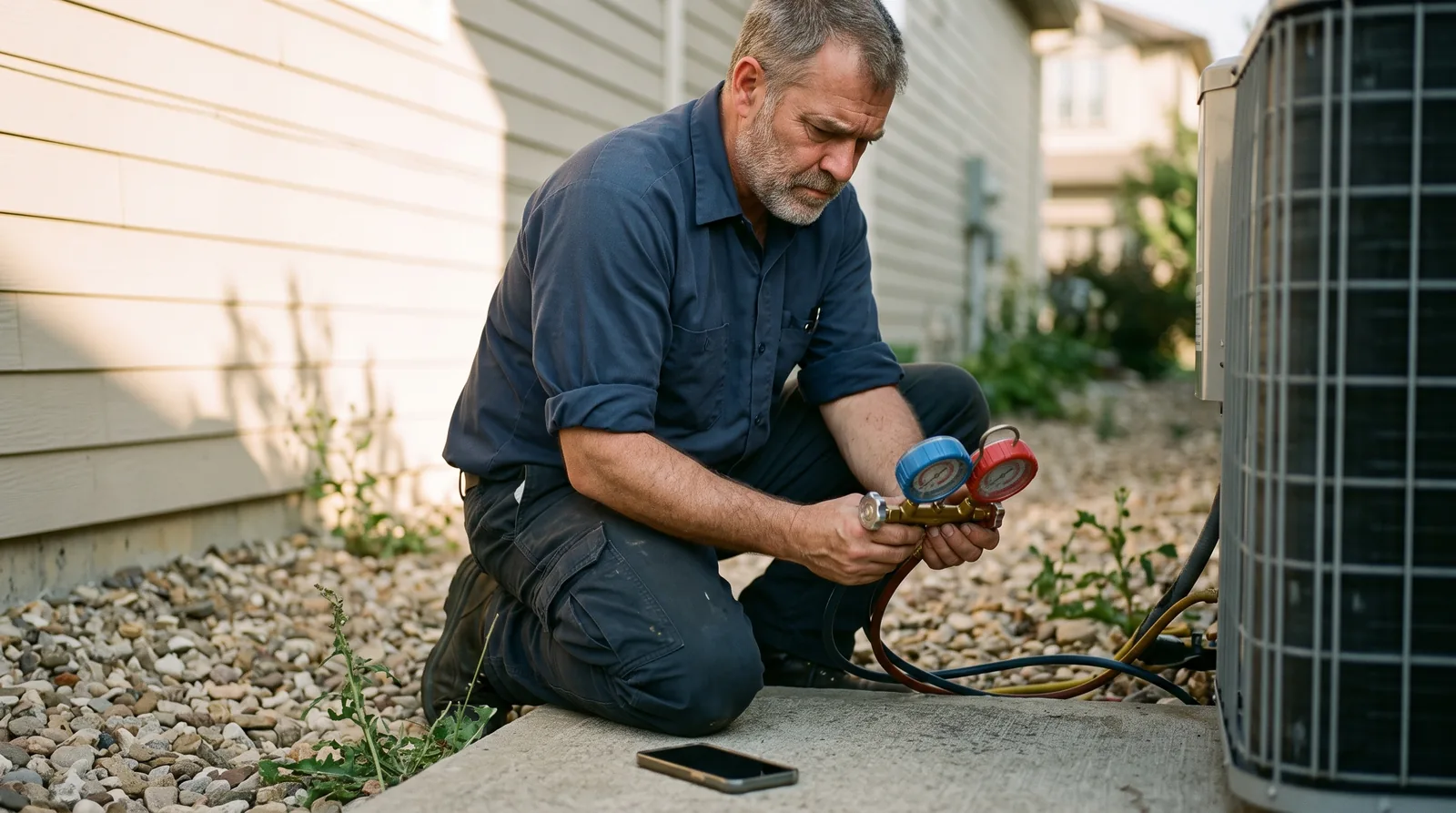
Illustrative. Hands full, phone on the pad. That is when the call comes in.
Three pieces, behind one phone number.
Answer and qualify
- Picks up inbound calls after hours, on weekends, and during the overflow when both office lines are already busy
- Asks your real intake questions: address and service area, system type and age, brand, whether there is water on the floor, whether the equipment is still under warranty
- Separates a true emergency from routine work using rules you write, not a generic guess at urgency
- Hands the call to a person the moment the situation calls for one
Text back and follow up
- Any call that still goes unanswered gets a text within seconds, sent from your business number
- The text asks the two questions you need to triage and offers a booking slot instead of a promise to call back
- The number is registered for A2P 10DLC before launch, because US carriers filter and surcharge unregistered business texting
- Second and third touches go out on a schedule you set, then stop on their own
Book, dispatch, write it down
- The job is written into the software you already run, if it exposes an API or a Zapier connection
- Your on-call tech is paged with the address, the symptom, and a callback number
- The caller gets a confirmation, which is the only reliable way to stop them dialing the next company
- You get one morning summary of what came in overnight and what it turned into
What the system does in the ninety seconds you are not there.
8:40:12. Call lands. Answered on the first ring. Caller says the AC quit this afternoon and the house is not cooling.
8:40:35. Intake runs: service address, confirmed inside your radius. Outdoor unit is running or not. Age and brand of the system. Whether the thermostat has power. Whether anyone in the home is medically vulnerable in the heat.
8:41:20. The answers trip the rule you wrote for a summer no-cool with a vulnerable occupant. That is an emergency dispatch, not a Monday slot.
8:41:40. Your on-call tech’s phone buzzes with the address, the symptom, the system age, and a tap-to-dial callback number. No transcript to read. No rekeying.
8:41:45. The homeowner gets a text confirming a tech is being dispatched and naming the window. They stop dialing.
8:42:00. The job exists in your software with the fields already populated, so Monday morning nobody is reconstructing what happened from a voicemail.
The competitor who answered at 8:44 was already too late.None of that is exotic. It is one method run in a fixed order: answer, qualify, hand off. The method is described in more depth on the Reclaim tier and in our write-up on after-hours call capture. What makes it work for a trade is that the intake questions and the escalation rules are yours, not a template.
Sometimes you should buy the $49 subscription instead.
Acuity AI Consulting wrote this page and sells one of the three options below, so here is the honest version. If you are a one-truck shop, you miss a handful of calls a month, and what you actually need is for somebody to take a message and text you the number, buy an off-the-shelf subscription. Rosie starts at $49 a month for 250 minutes and you can be live this afternoon. We do not compete there and would not want to.
If your call volume is genuinely low but every call is high-stakes and you want a human voice, a staffed answering service is a reasonable buy even at $300 a month for thirty calls. You are paying for a person, and a person is sometimes the right answer.
A custom build earns its money in one situation: you have real after-hours volume, a dispatch process that a generic script cannot follow, software you need the job written into, and jobs large enough that recovering a few a month covers the whole thing. Below $1,500 of recoverable work per year, do not build anything. Run the numbers first.
One thing to price in either way: the build fee is not the whole bill. Your voice platform and your phone carrier bill by the minute, and on a custom build you hold those accounts and pay them directly at their published rates. We do not mark that up and we do not add a meter on top of it, but it is a real line that grows with call volume. Vapi posts its rates at vapi.ai/pricing.
| What you are comparing | Staffed answering service | Subscription AI receptionist | Custom build |
|---|---|---|---|
| What it costs | |||
| Published entry price | $300 per month for 30 calls (Smith.ai) | $49 per month for 250 minutes (Rosie) | From $1,500 one-time |
| Past the plan | $8.50 to $11.50 per extra call, by tier | Move up a tier for more minutes | No per-call or per-minute charge from Acuity |
| Platform and telephony usage | Bundled into the per-call price, capped by tier | Bundled into the plan minutes, capped by tier | Billed to you directly by Vapi and your phone provider, at their published rates, no markup. Scales with call volume. |
| Ongoing support | Included in the subscription | Included in the subscription | Optional care plan, from $75 per month |
| What it knows about your business | |||
| Your intake questions | Whatever is in the script you supply | Whatever you type into the setup screen | Yes, built from your intake sheet |
| Emergency versus routine triage | Only as far as the script goes | Varies by plan | Yes, on rules you write |
| What happens after the call | |||
| Job written into your field service software | Usually a portal or an email | Varies by plan and integration | Yes, where an API or Zapier exists |
| On-call tech paged automatically | Depends on the plan | Varies by plan | Yes, by your escalation rule |
| Missed-call text-back from your number | Varies by provider | Varies by plan | Yes, on an A2P-registered number |
| What you end up owning | |||
| You own the finished system | No, it is a subscription | No, it is a subscription | Yes, built for you, owned by you |
| Time to live | Days | Same day on a self-serve plan | Weeks, because the rules come from you |
Want the number before the call?
Put your call volume and your average ticket into the missed-call cost calculator. If what comes out does not bother you, do not book anything. If it does, thirty minutes is enough to scope the fix.
Book a 30-minute callWhat contractors ask before booking.
Will it sound like a robot to my customers?
Fair question, and it is the one that sinks most of these projects. The system is built around your actual call flow, so it asks the questions your office would ask and hands off to a person the moment a caller needs one. The goal is not to replace the human on the calls that need a human. It is to make sure the call you were going to miss entirely turns into a booked job instead of a competitor’s good night.
What happens when a real emergency comes in at 2am?
You write the escalation rules and the system follows them. A no-heat call in January is not the same as a dripping hose bib, and the intake questions are what tell the two apart. When a call trips your emergency rule, your on-call tech gets paged with the address, the symptom, and a callback number, and the caller is told someone is on the way instead of being left guessing.
Do missed-call text-backs actually get delivered?
Only if the number is registered first. US carriers require application-to-person 10DLC registration for business texting on an ordinary ten-digit number, and unregistered traffic gets filtered and charged extra carrier fees. Registration is part of the build, not something you discover three weeks after your texts quietly stopped landing.
Will it work with the field service software I already run?
If your software has an API or a Zapier connection, the job, the contact, and the call notes can be written into it so your office looks in one place instead of two. If you run on a shared calendar and a spreadsheet, that works too. The integration gets scoped on the call before anything is quoted, so nobody hits a wall halfway through the build.
What does this cost, and is there a per-minute charge?
Builds start at $1,500 as a one-time, custom-scoped project. After that, a care plan covering monitoring, prompt tuning, and small changes is optional and starts at $75 a month. A more active management tier, where things are being changed and watched every week, sits higher, around $300 a month. On usage: your voice platform and your phone carrier do bill by the minute, and that part is real. What we do not do is mark it up or add a meter of our own. You pay Vapi and your phone and messaging providers directly, at their published rates, on accounts in your own name, so that line scales with how many calls you take. Current rates are posted at vapi.ai/pricing. You own the finished system either way.
How long does it take, and what do you need from me?
Plan on a few weeks rather than a few days, because the value sits in your intake questions and your dispatch rules and those live in your head. Expect a kickoff call, one review while it is being built, and a handover. Bring your current call script if you have one, your service area, your after-hours rules, and the two or three call types you never want to miss.
More on how an engagement runs is on the process page, and the general FAQ covers tools, security, and timelines.
Let’s find the call you keep losing.
Thirty minutes. We’ll tell you what we’d build, what it would cost, and whether it is worth doing at all.
Book a 30-minute call